
This instant mawa with ricotta cheese is my shortcut for making soft, crumbly homemade khoya without boiling milk for hours. In fact, it takes less than 20 minutes. Full-fat ricotta, milk powder, cream and ghee are cooked down until thick, rich and grainy - perfect for Indian sweets like halwa, barfi and ghughra, and useful in rich savoury dishes too.
You can also make homemade khoya with milk powder.

Recipe Summary: Instant Mawa with Ricotta Cheese
- ✅ Recipe Name: Ricotta Mawa, Ricotta Khoya
- 🕒 Ready In: around 20 minutes
- 👪 Serves: 10 servings (easy to scale)
- 🍽 Calories: 211 per serving
- 🥣 Main Ingredients: Ricotta cheese, milk powder, double cream, ghee
- 📖 Dietary Info: Make-a-head friendly, vegetarian
- ⭐ Why You'll Love It: It gives you homemade mawa without hours of stirring milk. You can make it on the stovetop or in the microwave, use it straight away while soft or store it.
SUMMARIZE & SAVE THIS CONTENT ON
Jump to:
Note – This recipe has been updated from our recipe archives with further recipe testing. First published in June 2012.
Why I Make Mawa at Home
Mawa, also known as khoya, is one of those ingredients that appears again and again in mithai and Indian desserts. Essentially, it's a cooked down milk solid traditionally made by simmering whole milk slowly until most of the water evaporates and the milk solids are left behind.
Mawa adds richness, milkiness and that slightly grainy texture you cannot get from cream alone.
I use homemade mawa in so many J Cooking Odyssey recipes, either made from ricotta cheese or from milk powder. It is part of how I build Indian sweets at home, especially when fresh shop-bought mawa is not easy to find.
This instant ricotta mawa recipe gives you a practical homemade version using full-fat ricotta, milk powder, double cream and ghee. It is not exactly the same as traditional slow-reduced mawa, but it gives you a very useful soft, crumbly khoya for sweets and rich Indian dishes.
Ricotta Mawa vs Milk Powder Mawa
On my blog, I use two main homemade mawa methods: this ricotta mawa and my homemade khoya with milk powder.
Both are useful, but I do not use them in exactly the same way.
Ricotta mawa is softer, crumbly and slightly grainy. I like it best for sweets where that texture works in your favour, such as gajar halwa, milky dodha barfi, soft and creamy coconut barfi, aate ka halwa with mawa and mawa ghughra.
Milk powder mawa is smoother, stickier and more interchangeable. I use it when I want a smoother base or a richer dough-like texture, such as in mawa peda, gulab jamun with khoya, kesar mawa na penda and kala jamun.
Some recipes can use either, depending on the texture you want. For example, eggless mawa cake works well with homemade mawa, but the mawa should be fairly dry and crumbly so it does not add too much moisture to the cake batter.
If I need mawa for a sweet and I am not sure which version to use, milk powder mawa is usually the more flexible option. If I specifically want a grainier, crumbly texture, I choose ricotta mawa.
The 4 Ricotta Mawa Ingredients
Full-fat ricotta cheese
I only use full-fat ricotta for the best texture. Lower-fat ricotta can be more watery and less rich, which means the mawa may take longer to cook down and will not taste as creamy.
I use fresh, creamy full-fat ricotta cheese - the kind sold in supermarket tubs. It should look soft, moist and spoonable, almost like a grainier mascarpone.
Avoid very dry, crumbly or heavily grainy ricotta-style cheese for this recipe. Some Turkish and international grocery shops sell ricotta-style or lor-style cheese that is much thicker and drier. That type is lovely for other uses, but it will not cook down into the same soft, creamy mawa texture here.
Use any leftover ricotta to make Ricotta Cheese Peda, this Instant Kalakand with 2 ingredients or One Pot Ricotta Lemon Pasta.
Milk powder
Milk powder helps absorb moisture from the ricotta and gives a stronger milky flavour. Use full-cream milk powder if you can.
Double cream
Double cream adds richness and helps the ricotta mawa taste more like khoya rather than just cooked cheese. US readers can use heavy cream.
Ghee
Ghee adds flavour and helps the mawa cook into a soft, rich mass. I tend to use homemade ghee (I'm sure you can sense a theme here) or shop-bought ghee.
Let's Make Ricotta Mawa Together
The stovetop gives you the most control because you can see the ricotta mixture changing from loose and creamy to thick, grainy and crumbly.
The microwave method is still useful, especially when you want less hands-on stirring.
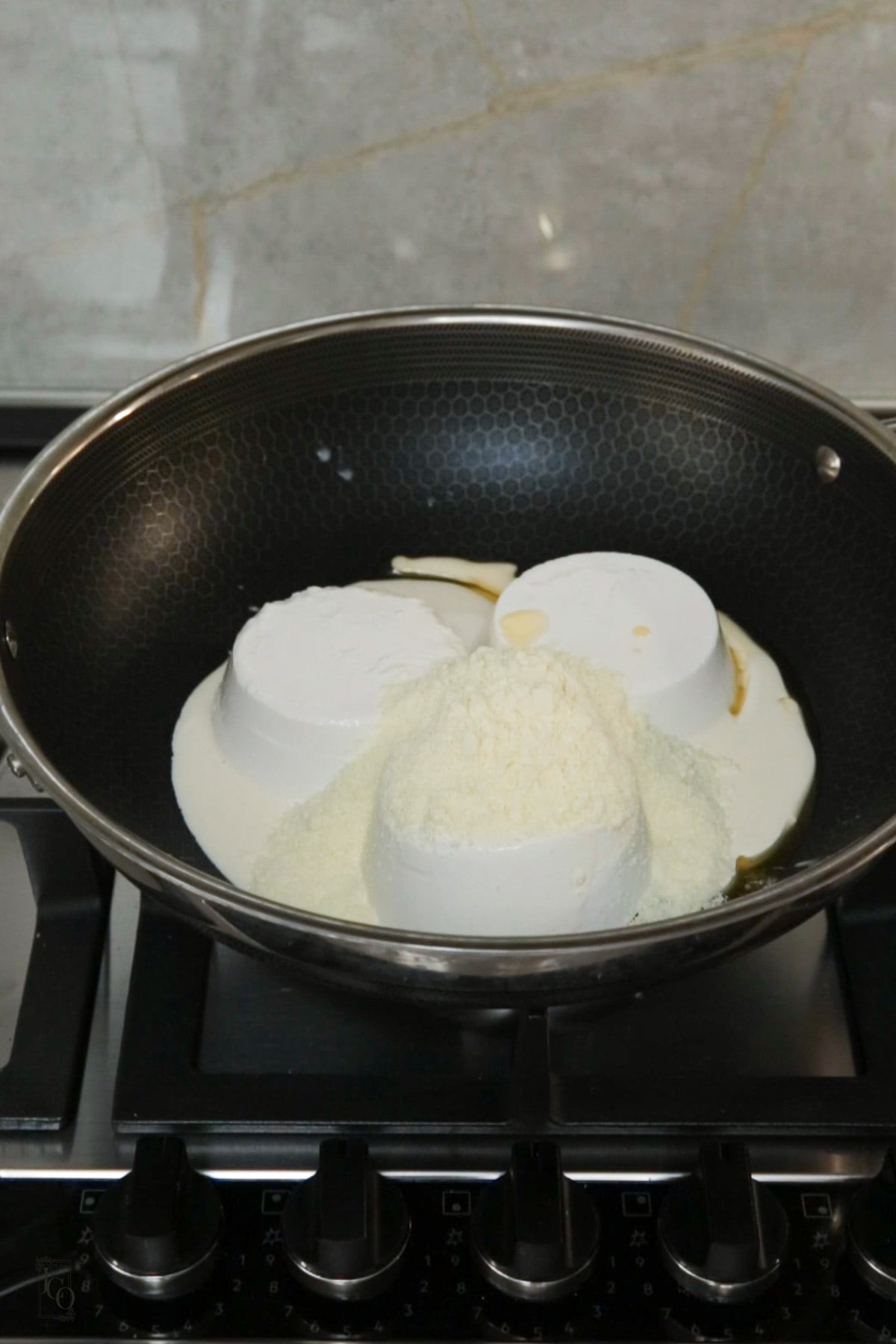
- Add everything to the pan: Add the ricotta cheese, milk powder, double cream and ghee to a heavy-based pan. At this point it will look separate and unmixed.
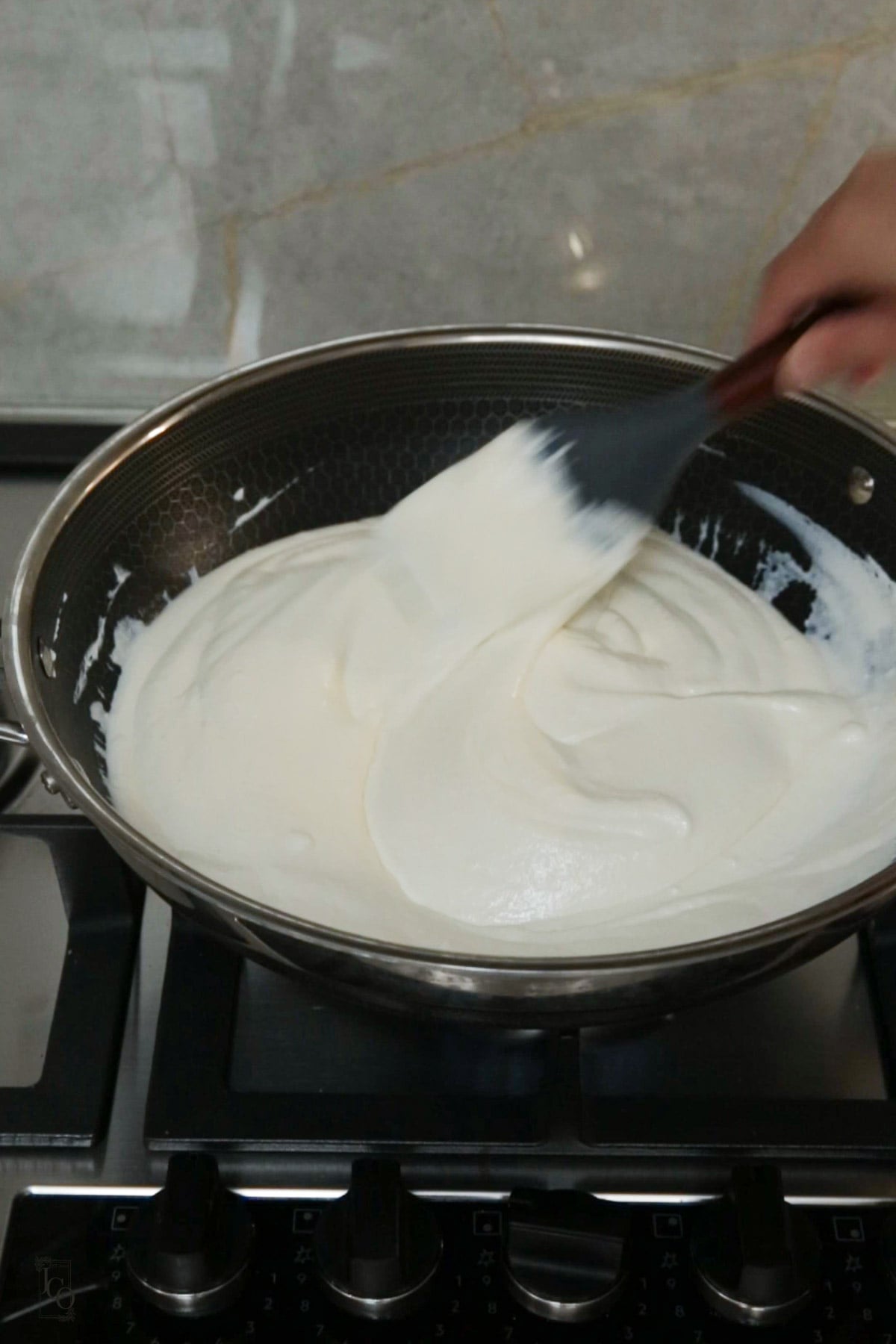
- Stir until melted and runny: Cook on low to medium heat, stirring well. The mixture will loosen first and look creamy, melted and quite runny. This is normal.
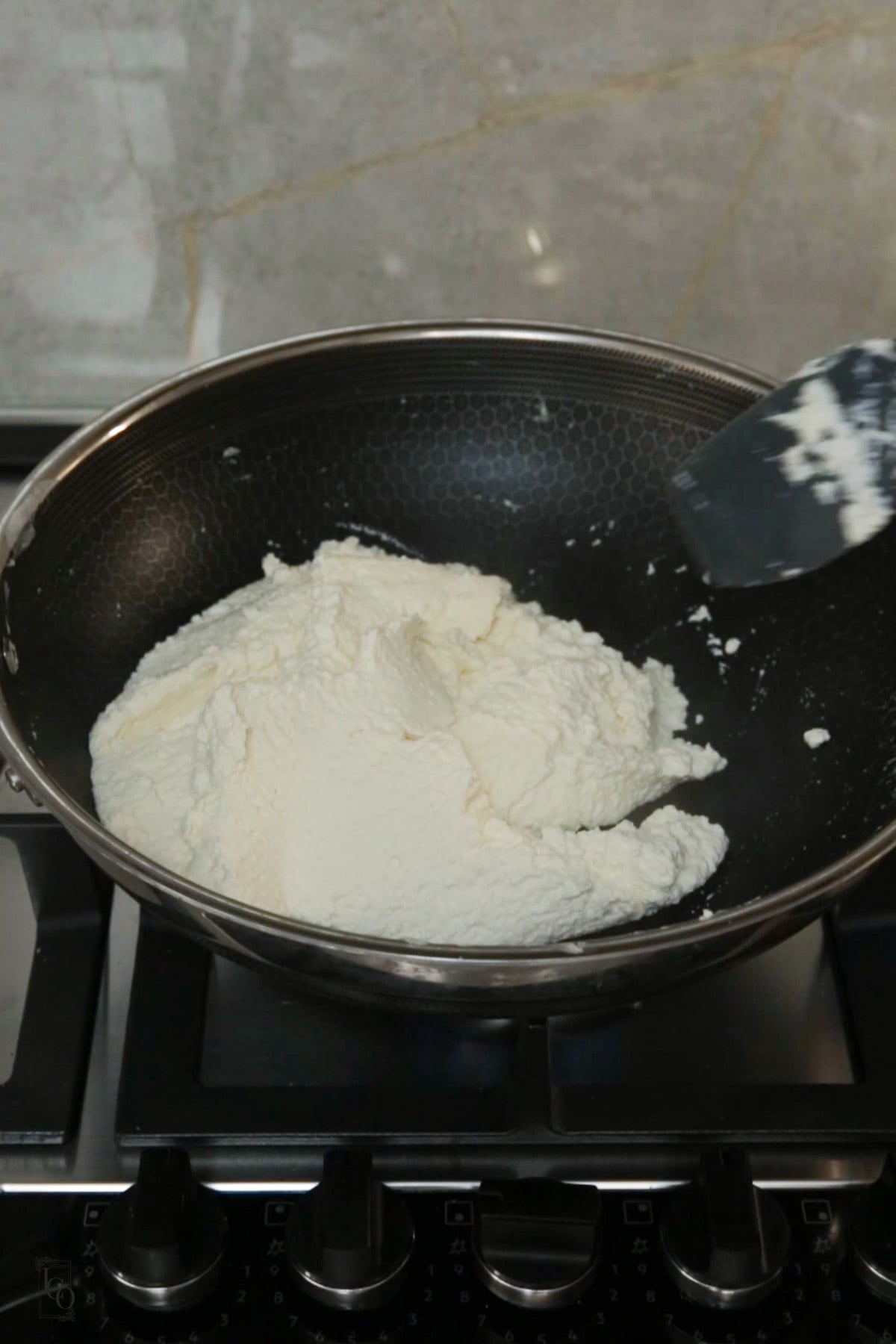
- Keep cooking until it thickens: Continue stirring as the moisture cooks off. The mixture will start to look thicker, grainier and heavier in the pan. Stir more often now so it does not catch.
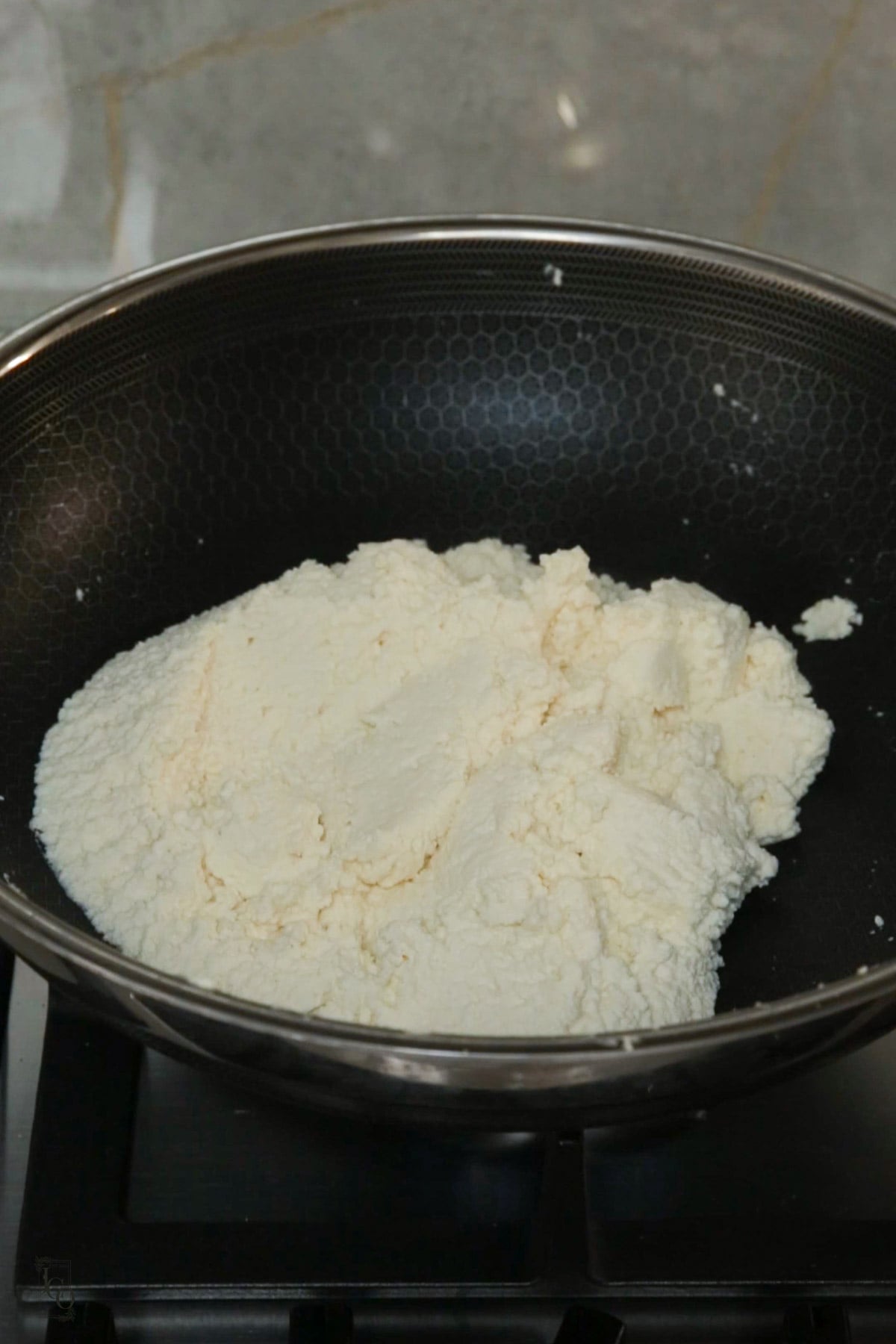
- Cook until it forms a soft mass: The mawa is ready when it comes together in one thick, soft, crumbly mass and starts pulling away from the pan. Remove it from the hot pan so it does not keep drying out.
The finished ricotta mawa should be soft, thick, crumbly and slightly grainy. It should not be runny or wet but it should not be completely dry and hard either.
Storage
Cool the ricotta mawa completely before storing.
Store in an airtight container in the fridge for up to 1 week.
You can also freeze it for up to 3 months. Defrost in the fridge before using.
If the mawa feels slightly moist after chilling, cook it for a few minutes in a pan before adding it to a recipe.
How To Use Ricotta Mawa
Ricotta mawa is useful anywhere you want soft, crumbly khoya texture without spending hours reducing milk.
I especially like it in recipes where a slightly grainy dairy texture works in your favour. It can add richness to Indian sweets, body to festive bakes, and a gentle milky creaminess to special-occasion savoury dishes.
For sweets, think of ricotta mawa as a good choice for recipes where the texture does not need to be completely smooth. It works well in halwa-style sweets such as rajgira sheera, where mawa adds a subtle graininess to the soft halwa texture.
It is also useful in paneer and mawa sweets where a dense, rich texture is part of the charm, such as pistachio paneer rolls or beetroot kalakand.
For Gujarati mithai, ricotta mawa can work in recipes where you want richness and a crumbly finish, such as mohanthal or dhilo mohanthal. Just make sure the mawa is not too wet before adding it.
Mawa is not only for sweets either. A small amount can make savoury curries feel richer, thicker and more luxurious.
Use it in dishes such as khoya kaju, where khoya is part of the main gravy, or stir a little into rich paneer curries such as paneer tikka masala, shahi paneer or Punjabi matar paneer when you want extra body and creaminess.
For savoury recipes, use ricotta mawa sparingly. It should make the gravy feel richer, not sweet or heavy.
As always if you make this recipe, be sure to leave me a comment, rate this recipe and tag me on Instagram @jcookingodyssey or #jcookingodyssey. I love seeing all your photos of my recipe recreations!
Don’t forget to follow me on social media using the buttons below – I can't wait to see you all there!
📖 Recipe

Instant Mawa with Ricotta Cheese
Ingredients
- 750 grams ricotta cheese fresh
- 9 tablespoon milk powder full cream
- 9 tablespoon double cream heavy cream
- 3 tablespoon ghee
Instructions
Stovetop Method
- In a heavy bottomed pan, add 750 grams ricotta cheese, 9 tablespoon milk powder, 9 tablespoon double cream, and 3 tablespoon ghee.
- Mix well and cook the mixture on low to medium heat. Keep stirring continuously.
- You will begin to see the mixture thicken in consistency and come together as one mass. This can take up to 15-20 minutes but depends on the quantity and consistency of your ricotta cheese.
- Turn off the heat and remove the mawa from the hot pan to prevent further cooking. Store or use immediately.
Microwave Method
- In a microwave safe bowl, add 750 grams ricotta cheese and stir until loosened. Microwave on HIGH for 3 minutes, checking at minute intervals.
- Stir well and add 9 tablespoon milk powder, 9 tablespoon double cream and 3 tablespoon ghee. Stir again and M/W on HIGH between 4-5 minutes. Again, keep checking at minute intervals and stir. You are aiming for a thick mixture that forms a single, thick mass. Microwave further if required.
- Allow to cool before storing or use in your recipe.
Video
Notes
- Use full-fat ricotta for the best flavour and texture.
- Mix the ricotta, milk powder, cream and ghee before the pan gets too hot.
- Cook on low to medium heat and stir often.
- The mawa is ready when it looks thick, crumbly and comes together in a soft mass.
- For immediate use, keep the mawa soft and crumbly.
- If storing in the fridge, cook it slightly drier so it holds better.
- Remove the mawa from the hot pan once cooked so it does not keep drying out.
- Ricotta mawa is more grainy and crumbly than milk powder mawa.
- Use ricotta mawa for halwa, barfi, ghughra and recipes where a grainy texture is welcome.
- Use milk powder mawa when you need a smoother, stickier and more flexible mawa.
- Store in the fridge for up to 1 week or freeze for up to 3 months.
Nutrition
PLEASE NOTE: Nutritional values are estimated by a computer and may vary based on ingredients and portion sizes. For personalised dietary advice, please consult a qualified healthcare professional.
Share on Facebook Pin This Recipe


Anita says
Add sugar to this and it becomes instant kalakand. I make Kalakand like this.
Hayley Dhanecha says
Anita
Yes, we have a Ricotta cheese kalakand recipe made with condensed milk. Have a look.
KANUMILLI HARIKRISHNA says
Could you please where is mawa in UK? I didn't find it
Emily says
The other decent advantage that you get while doing such an excess of searing and preparing is not warming the kitchen to such an extent.
Rit says
Thank you once again. Just wondering if I can use the ready made packets of paneer in the kala jamun recipe instead of the fresh paneer?
jcookingodyssey says
yes, you can 🙂
Rit says
Hi there, just come across your recipe. Looks really easy. Can I use this maya recipe when making Kala Jamun?
jcookingodyssey says
Yes, you can.
Rit says
Thanks for the response. Do you have a kala Jamun recipe to use with your mawa recipe
jcookingodyssey says
yes I have..just type in search box you will be able to find a link for Kala Jamun recipe.
Unknown says
what will be quantity of mawa out from this amout of ingredients?
jcookingodyssey says
I would say about 250-270 g of khoya will be yield.
Unknown says
How can this type of mawa be stored and for how long?
Hayley Dhanecha says
Store in the fridge for up to 1 week or freeze for up to 3 months.
Unknown says
How can this mawa be stored and for how long?
Unknown says
How can this type of mawa be stored and for how long?
jcookingodyssey says
Shazia, I made few weeks ago and I left in the fridge NOT Freezer..it was fine after even one week. You can freeze too and it stays good for month or two.
Priya Suresh says
Simply loving this short cut method for mawa,thanks for sending to MEC Jags.
Rachana says
I gotta try this out 'coz making mawa the traditional way is indeed a time consuming affair. Thanks for sharing!
Savi-Ruchi says
I always made mava with milk powder. Will try this for sure. Thanks for sharing!